Hello blog followers,
It has been a crazy couple weeks and I'm happy with the final result. I feel like i have learned a lot. I started at zero and now I am where I am. I wouldn't say I am now an expert, but I have definitely laid down a good foundation for when I further study microeconomics.
Studying it was different than I thought. I went in with the ideas that it could help me manage personal finances better but it never really dove into that. For the most part the topics seemed to be for companies who run studies, or closely watch their products. Its a topic that would be above the heads of normal people including myself. But that doesn't mean that it wasn't worth learning because I thought that it totally was. From a stand point of investing, the lessons often gave scenarios about how certain event can transform the profit that a company can make, and in that way it was very useful.
For now I am going to ease on the break a bit. I wont necessarily stop, but I am going to learn at a slower pace.
As for my TED Talk, I am proud of the result. My goal for it was to put a little twist of my own on microeconomics. I could have gone up there and said a bunch of boring fact or statistics, but I didn't want to. I wanted to shine a new light on the topic. And that the reason I used the topic of Value (sentimental value). When I started my topic I realized that a lot of the ideas could be used for other purposes. Like the demand curve doesn't have to just represent people buying a product, It could represent college accepting student and things like that.
At first it was hard to come up with ideas. Like besides changing up the supply and demand curve I wanted to touch on more advanced topics and It was hard to further my analogies. Finally, I came up with the idea of talking about producer surplus and marginal cost, and it worked perfectly.
Its sad to see a project like this come to an end. It does make the whole project to have so much freedom in the ares you want to study. And thats one of the reason this has been one of my favorite projects. So goodbye to my followers. Goodbye to this project. It was fun while it lasted.
Joe out *drops microphone*
Thursday, March 26, 2015

Monday, March 23, 2015
Post #5
Hey squad,
I am continuing to expand my knowledge on microeconomics each week and I can say that I am starting to get better at it. I feel like it was just understanding those first basic concepts that are the hardest and then after that the rest is easy. Thats not to say that a lot of this doesn't confuse me, because it does, but its definitely a little easier to pick up on.
Now I'm not going to go into my normal lecture on what I learned. I have heard from many of my blog followers that they don't understand a lick of what I am saying. And that makes sense. I was never really trying to teach you guys what I learned, it just so happen that the way I talked about my topic sounded like a lecture. So I'm sorry for that. Its just hard to show my final product by any other means besides explaining what I know.
So anyways....
This week I came across a lesson that I thought was cool, even though that might be the wrong term for it. The lessons was about taxation of a certain industry. The example that Khan Academy used was the hamburger industry. And in his scenario, he said that every burger was taxed one dollar. And was a result of this taxation the supply and demand curves graphs changed. The curves stay where they are but a new supply curve is added. And its the supply curve for the government. And as you can guess it rests about $1 above the other supply curve. This can be shown in the picture below.

I am continuing to expand my knowledge on microeconomics each week and I can say that I am starting to get better at it. I feel like it was just understanding those first basic concepts that are the hardest and then after that the rest is easy. Thats not to say that a lot of this doesn't confuse me, because it does, but its definitely a little easier to pick up on.
Now I'm not going to go into my normal lecture on what I learned. I have heard from many of my blog followers that they don't understand a lick of what I am saying. And that makes sense. I was never really trying to teach you guys what I learned, it just so happen that the way I talked about my topic sounded like a lecture. So I'm sorry for that. Its just hard to show my final product by any other means besides explaining what I know.
So anyways....
This week I came across a lesson that I thought was cool, even though that might be the wrong term for it. The lessons was about taxation of a certain industry. The example that Khan Academy used was the hamburger industry. And in his scenario, he said that every burger was taxed one dollar. And was a result of this taxation the supply and demand curves graphs changed. The curves stay where they are but a new supply curve is added. And its the supply curve for the government. And as you can guess it rests about $1 above the other supply curve. This can be shown in the picture below.
And the result of this new supply curve changes the equilibrium for that industry. That can be seen where the intercepts are. And its because of that change that the producers, and the industry as a whole, suffers.
This change in equilibrium changes the producer surplus and decreases it. And in english I am basically saying that because there is now a tax, a lot of the money that the producer makes goes down. Where does that money go? The answer is two places. The first, is some of the money now goes to the government. And the second is that the money disappears in general, as indicated from the blue triangle. The blue is the deadweight loss for that industry. The area of that triangle basically tells us that the industry lost money because of the taxation. No longer is that surplus going to the consumer or to the producer but its going to another industry, something different.
And I just found it interesting how legislation like that could change an industry so much. I thought it was cool and maybe an idea worth sharing because It could definitely help someone who is into investing. Because now you know that if the government were to make a tax, or something like that, on an industry you can assume that the value of the industry will decrease. This is because A) the producer is making less money and B) there is now this deadweight loss that is no longer going towards that industry. So as an investor I would keep track of things like that.
I hope I didn't contradict myself and write another boring lecture. I thought that maybe some of you guys would find that as interesting as I did, and maybe it could help people like Jake F. when it comes to his investing. Thanks
Thursday, March 12, 2015
VLOG
Hey Squad,
This is my Vlog post. Sorry if its a little long. Its hard to explain everything in such little time. Makes me worried about the TED Talk.
Monday, March 2, 2015
#3
Gonna be honest, I thought that my last cycle's information was easy. Because compared to this week it was cake. This week I learned all about elasticity which was tuff. And its kind of like the elasticity that you would think of like a rubber band. But the stretch and compression has to do with price and demand. Its more with how price affects demand but it compared two points on the demand or supply curve. And It is usually used so a company can determine what will happen if a price changes and how it will affect the quantity supplied or demanded.
I learned about 3 different kinds of elasticity, elasticity of demand, elasticity of supply, and cross elasticity. Ill try to explain elasticity of demand because the other elasticities are basically the same.

So here is our demand curve. Just as a refresher, as price goes up the quantity demanded goes down. Now elasticity is basically how does the change in price affect the quantity demanded and when we calculate elasticity we should arrive at a number. So in the chart above we have a point at p1 and q1 and then we have a point at p2 and q2. Lats assume point one has a price of $10 and a quantity of 7 while the other point has a price of $8 and a quantity of 11. With theses numbers we use the formula for elasticity which is (% change in quantity)/(%change in price). Lets start with the % change in quantity. To calculate this you do the difference of the prices over the average of the two (the reason we use the average of the two prices is because this makes the elasticity the same when you go from p1 to p2 or if you go from p2 to p1). So with is formula we find that the %change equals -2/9.
Now lets calculate the % change in price. Using the same formula as the other one we do difference/ average. So the difference of 7 to 11 is 4 and the average of the two is 9. so we have the % change in price as 4/9.
Lets put this into our elasticity formula %change in quantity over % change in price. Which is (-2/9)/(4/9). And this gets us -0.5. Usually its the absolute value o this number so we are left with 0.5. And this is the elasticity.
The way we interpret this number is called inelastic. This basically means that the number we arrived with was less than one. If the number was 1 or close to one, that would be unit elasticity, and if the number was greater than one then it would be elastic.
Companys will then use this number to find how much a change in price will affect the quantity. And it is from this elasticity that companies try to strive for an elasticity of 1 or the unit elasticity. At this point the amount of money you make (price * quantity) is at its greatest value.
Thats basically what I got out of all the videos and I hope I explained that right. Elasticity of supply is the same thing but with supply. And then cross elasticity is seeing how the price of another company affects the quantity demanded of your company.
I hope these videos get easier to follow. If you have any questions comment below :)
Sunday, February 22, 2015
Week two
I just finished my first set of lessons from khan academy and I can soundly say I am interested. The think I like the most about microeconomics is that there is always that "ahh haa" moment about halfway through the video. Sal, the guy who does the videos, will start the video will the basic idea that you will be learning and at first you don't really understand it, but then as he explains scenarios and makes graphs, you reach the point where you finally understand what he is talking about. Ill give a couple examples so you can understand what I mean.
Demand
So demand was the first thing you learn from khan academy (like supply and demand). This was probably the easiest thing to understand. Basically if all variables stay the same, as the price of a product goes up the quantity demanded goes down. And at first that might be confusing but when you think about it, it is basically saying that as a price goes up less people will want it. As simple as that.
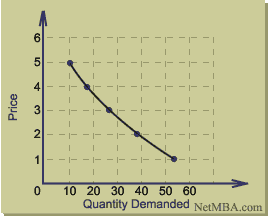
A common misconception about demand it that it is a number. It is not. Demand refers to a curve, an equation. This is what demand looks like:

So this is the demand curve and this is what is referred to when demand is brought up. And it is from this curve that the quantity demanded is obtained. Lets assume this represents the demand of Apples per lb. At $5 per pound only about 10,000 apples will be sold, this 10,000 is the quantity demanded. If the price drops $1 the quantity demanded will be 54,000. This graph can shift left or right depending on many things but I wont go into them because there are a lot of different scenarios.
Supply
The next couple videos were all about supply. And this is where things got complicated. As the price of a product goes up the quantity produced will go up. As this is basically saying that in the apple market, the market price for apples goes up to about $4 a pound. Apple producers will respond to this by saying that they should produce more apples (make more money). So the supply quantity (the amount of apples produced in the future) will increase. And here is the supply curve:


Demand
So demand was the first thing you learn from khan academy (like supply and demand). This was probably the easiest thing to understand. Basically if all variables stay the same, as the price of a product goes up the quantity demanded goes down. And at first that might be confusing but when you think about it, it is basically saying that as a price goes up less people will want it. As simple as that.
A common misconception about demand it that it is a number. It is not. Demand refers to a curve, an equation. This is what demand looks like:
Supply
The next couple videos were all about supply. And this is where things got complicated. As the price of a product goes up the quantity produced will go up. As this is basically saying that in the apple market, the market price for apples goes up to about $4 a pound. Apple producers will respond to this by saying that they should produce more apples (make more money). So the supply quantity (the amount of apples produced in the future) will increase. And here is the supply curve:
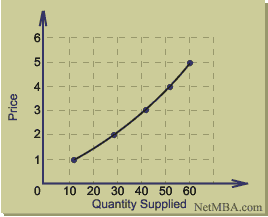
So lets assume the price of apples on the market is 5 dollars a pound. As a producer I want to make more money so I will respond to this by focusing on making apples and producing more. So next grow season I will grow 60,000 apples. If the price of apples goes down to $1 I will produce only 12,000 apples next grow season and maybe focus more on other produce like grapes.
Equilibrium
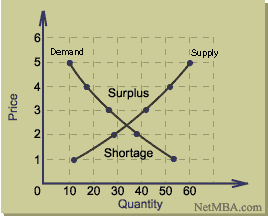
So supply and demand is usually graphed on the same axis and is used by companies to figure out how much to produce and what you usually find is that the price and quantity will usually hit a point of equilibrium. Ill explain:
So lets assume the cost of apples increases to $5. In response the apple producer will make more apples, 60,000. But if we move our view over to the demand curve at $5 for apples we see that at that price only about 10,000 apples will be sold. So essentially this is a surplus of 5,000 apples. These apples will go bad and the company will lose money.
So in response the company lowers the price to $1 an apple. They know they wont be making too much money so they produce only 10,000 apples. Now if we look at the demand curve we see that at $1 people want to buy 55,000 apples. But only 10,000 was produced. So now there is a shortage of apples.
Eventually the company will meet the point where the two curves intersect and that is considered the point of equilibrium. At that point the price is enough so that the quantity demanded and the quantity supplied will be the same. That makes for a happy company :).
Oil prices
The last thing I leaned was oil prices and how oil and gas are connected and how their price is driven. Im not going to dive into all of it because it is a lot to explain but I recommend you guys watch them.
Wednesday, February 11, 2015
Yay!! My first post
For my genius project I have decided to focus on microeconomics for the next 6 cycles. This is a sub category of economics. Microeconomics focuses on the distribution and production of wealth for individuals. These individuals can be people, companies, or groups of people. It is the opposite of macroeconomics which focuses on big picture ideas and how they affect people as a whole. The reason I want to study this topic is because I have a firm belief that money runs the world and is the reason for a lot of thing, so if you can understand money you can understand the world. I also see economics as a future career path, so this project could give me a sense of what the career is like.
Most of my research for this topic will come from Khan Academy. This is a website which offer videos and tutorials on many topics ranging from math to art. On Khan Academy, under the finance and economics section, there is a microeconomics section where they offer 77 videos on microeconomics. My goal by the end of the project is to have watched all of them.
By the end of this project I am hoping that I will reach certain goals. My first is better managing my personal finances. I feel as though these videos will teach me so much more about money and better ways to spend it. My second goal is to better understand the economy, like why a company did this and how it affects there stock. And lastly, I would like to get out of this a better understanding of the world.

Most of my research for this topic will come from Khan Academy. This is a website which offer videos and tutorials on many topics ranging from math to art. On Khan Academy, under the finance and economics section, there is a microeconomics section where they offer 77 videos on microeconomics. My goal by the end of the project is to have watched all of them.
By the end of this project I am hoping that I will reach certain goals. My first is better managing my personal finances. I feel as though these videos will teach me so much more about money and better ways to spend it. My second goal is to better understand the economy, like why a company did this and how it affects there stock. And lastly, I would like to get out of this a better understanding of the world.
This is what most of my research will look like. Khan Academy posts videos like these where I will watch them and take notes.
Subscribe to:
Posts (Atom)