Sunday, February 22, 2015

Week two

           I just finished my first set of lessons from khan academy and I can soundly say I am interested. The think I like the most about microeconomics is that there is always that "ahh haa" moment about halfway through the video. Sal, the guy who does the videos, will start the video will the basic idea that you will be learning and at first you don't really understand it, but then as he explains scenarios and makes graphs, you reach the point where you finally understand what he is talking about. Ill give a couple examples so you can understand what I mean.

Demand
      So demand was the first thing you learn from khan academy (like supply and demand). This was probably the easiest thing to understand. Basically if all variables stay the same, as the price of a product goes up the quantity demanded goes down. And at first that might be confusing but when you think about it, it is basically saying that as a price goes up less people will want it. As simple as that.
      A common misconception about demand it that it is a number. It is not. Demand refers to a curve, an equation. This is what demand looks like:
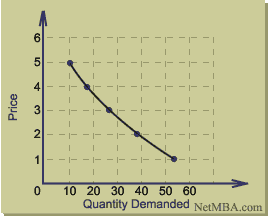

         So this is the demand curve and this is what is referred to when demand is brought up. And it is from this curve that the quantity demanded is obtained. Lets assume this represents the demand of Apples per lb. At $5 per pound only about 10,000 apples will be sold, this 10,000 is the quantity demanded. If the price drops $1 the quantity demanded will be 54,000. This graph can shift left or right depending on many things but I wont go into them because there are a lot of different scenarios.

Supply
         The next couple videos were all about supply. And this is where things got complicated. As the price of a product goes up the quantity produced will go up. As this is basically saying that in the apple market, the market price for apples goes up to about $4 a pound. Apple producers will respond to this by saying that they should produce more apples (make more money). So the supply quantity (the amount of apples produced in the future) will increase. And here is the supply curve:
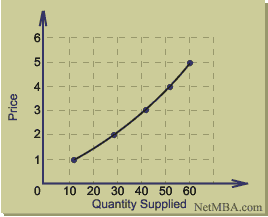
        So lets assume the price of apples on the market is 5 dollars a pound. As a producer I want to make more money so I will respond to this by focusing on making apples and producing more. So next grow season I will grow 60,000 apples. If the price of apples goes down to $1 I will produce only 12,000 apples next grow season and maybe focus more on other produce like grapes.

Equilibrium
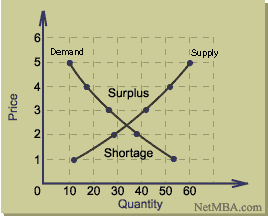
        So supply and demand is usually graphed on the same axis and is used by companies to figure out how much to produce and what you usually find is that the price and quantity will usually hit a point of equilibrium. Ill explain:
        So lets assume the cost of apples increases to $5. In response the apple producer will make more apples, 60,000. But if we move our view over to the demand curve at $5 for apples we see that at that price only about 10,000 apples will be sold. So essentially this is a surplus of 5,000 apples. These apples will go bad and the company will lose money. 
         So in response the company lowers the price to $1 an apple. They know they wont be making too much money so they produce only 10,000 apples. Now if we look at the demand curve we see that at $1 people want to buy 55,000 apples. But only 10,000 was produced. So now there is a shortage of apples. 
          Eventually the company will meet the point where the two curves intersect and that is considered the point of equilibrium. At that point the price is enough so that the quantity demanded and the quantity supplied will be the same. That makes for a happy company :).

Oil prices
The last thing I leaned was oil prices and how oil and gas are connected and how their price is driven. Im not going to dive into all of it because it is a lot to explain but I recommend you guys watch them.


Wednesday, February 11, 2015

Yay!! My first post

        For my genius project I have decided to focus on microeconomics for the next 6 cycles. This is a sub category of economics. Microeconomics focuses on the distribution and production of wealth for individuals. These individuals can be people, companies, or groups of people. It is the opposite of macroeconomics which focuses on big picture ideas and how they affect people as a whole. The reason I want to study this topic is because I have a firm belief that money runs the world and is the reason for a lot of thing, so if you can understand money you can understand the world. I also see economics as a future career path, so this project could give me a sense of what the career is like.
Most of my research for this topic will come from Khan Academy. This is a website which offer videos and tutorials on many topics ranging from math to art. On Khan Academy, under the finance and economics section, there is a microeconomics section where they offer 77 videos on microeconomics. My goal by the end of the project is to have watched all of them.
By the end of this project I am hoping that I will reach certain goals. My first is better managing my personal finances. I feel as though these videos will teach me so much more about money and better ways to spend it. My second goal is to better understand the economy, like why a company did this and how it affects there stock. And lastly, I would like to get out of this a better understanding of the world.

This is what most of my research will look like. Khan Academy posts videos like these where I will watch them and take notes.